RESOURCES
test
The Green Building Certification Process
Although each certification system has its own specific procedures, every project’s path to green certification generally follows the same main steps, in the following order.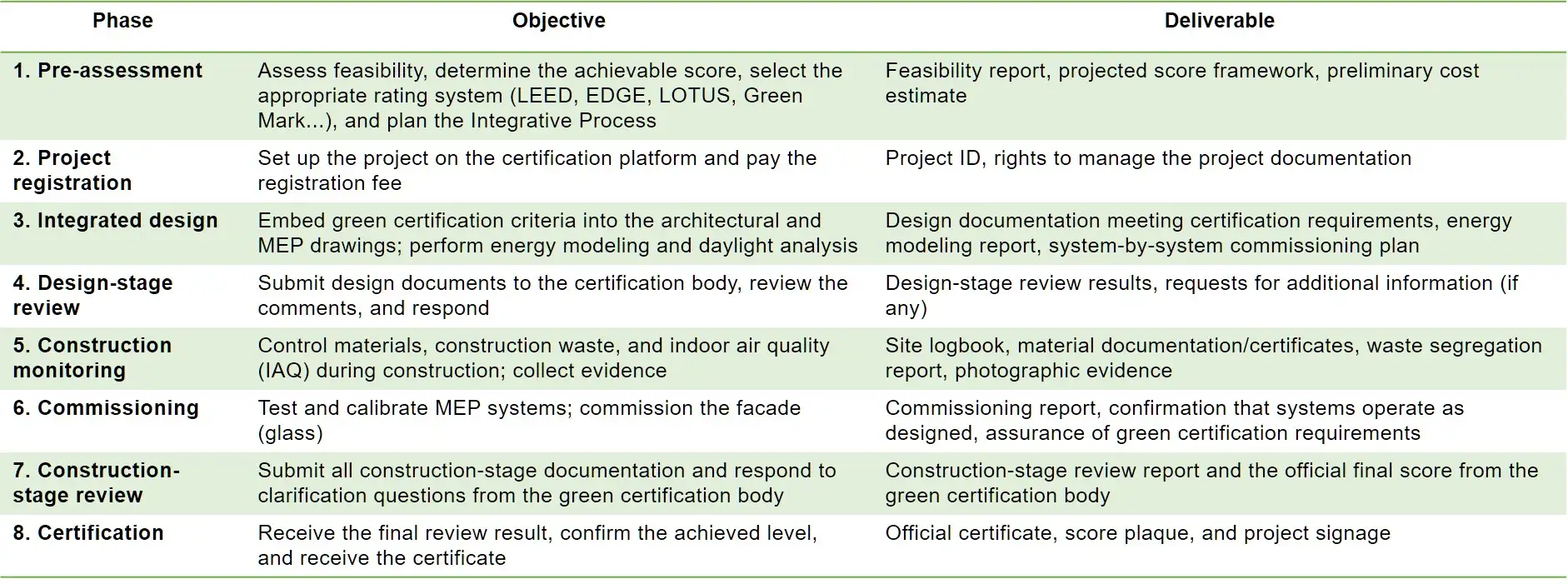
Green Certification Costs
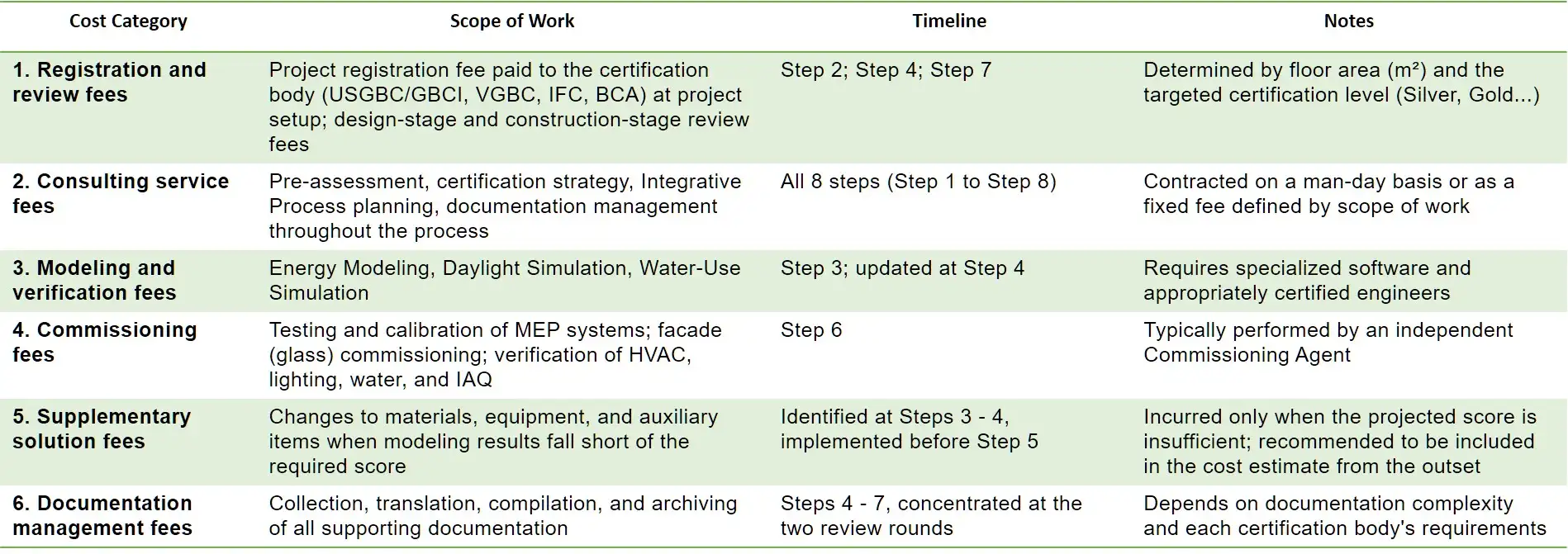
Most people assume that green certification consulting is just a single “service fee.” In practice, the cost of green certification is the sum of several distinct cost groups, each incurred at different stages throughout the project lifecycle.
Specifically, the cost structure falls into six main groups. Only when all six are combined do you get the true cost of a certification project. That total can vary widely depending on when the project starts — the key factor analyzed next.
Edeec tham gia ở đâu trong quy trình này?
Edeec does more than manage certification documentation. What sets us apart is the integration of Certification Strategy with Energy Modeling and Technical Optimization.
In a typical green consulting engagement, the green consultant receives the architectural and MEP design package from the design consultants, feeds it directly into the energy model, and calculates the green score.
This approach essentially answers the question, “Does the current design meet certification, and what needs to be added to reach the target score?” — rather than, “Is the design already optimized in technical and cost terms?” As a result, all engineering solutions and their associated costs are kept as originally proposed.
Edeec is the only green consultant that takes a broader approach: from the design stage, we use the energy model to verify and challenge the architectural and MEP design, identifying items that may be over-invested relative to actual need or where more effective alternatives exist.
Through energy simulation and quantitative analysis, we pinpoint the items that can be optimized, propose adjustments to reduce CAPEX while still meeting certification targets, and evaluate the impact on OPEX and long-term operational performance. This gives the Developer a sound basis to choose the right option — balancing certification points, investment cost, and building operational efficiency.
Field experience shows that this approach can help projects reduce OPEX by up to 30% and improve the green score by 15–20% without significantly increasing CAPEX, depending on each project’s characteristics and objectives.
Learn more about Integrated Technical Optimization at: BUILDING ENGERGY SIMULATION
For a detailed roadmap and a realistic cost estimate for your project, contact Edeec – Green Building Certification Consulting and Design Optimization
=====
Related Articles: