RESOURCES
Why Do Developers Need Green Building Certifications? Comprehensive Fundamentals
The real estate and construction sectors are entering a pivotal transition era. Concepts such as “sustainable development”, “Net Zero”, or “ESG” are no longer distant slogans on international forums, but have become existential imperatives and tangible competitive standards right here in Vietnam.
However, when facing these trends, many Project Developers still harbor substantial hesitation. The most common dilemma centers on the question: How much will pursuing green building certification increase initial capital expenditure (CAPEX)? This hesitation stems from a fundamental misunderstanding of the concept. This article systematizes foundational knowledge, providing Developers, Project Directors, and Chief Financial Officers with a brand-new perspective: Green does not mean expensive; green is a long-term profit optimization strategy.
1. Market Context
The commercial real estate market is entering a comprehensive restructuring driven by the compounding pressures of three converging waves: tightening global ESG standards, which prompt international financial institutions and investment funds to restrict low-cost capital disbursements for unsustainable projects; the shift in next-generation FDI inflows, where multinational corporations – bound by global supply-chain Net Zero commitments – strictly establish offices in spaces that meet international green standards; and escalating operational expenditure (OPEX) pressures driven by continuous energy price volatility, directly impacting asset profit margins across a 30- to 50-year operational lifecycle.
Amid an increasingly abundant supply of premium office space, green buildings are no longer an optional branding label, but have become an existential imperative for Developers to mitigate the risk of “asset obsolescence”, safeguard liquidity, and sustain their core competitive advantage.
2. What Are the Benefits for Developers Holding Green Building Certifications?
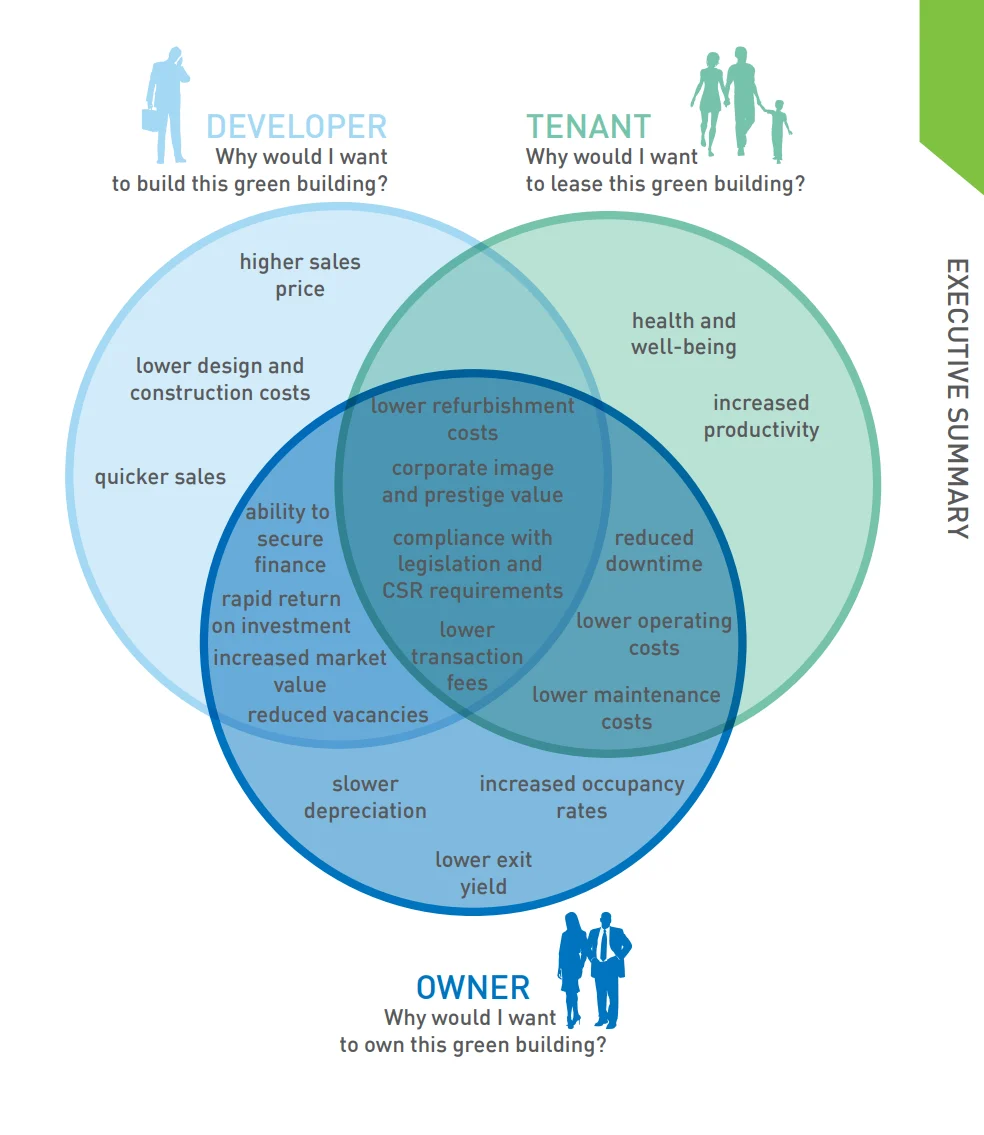
According to reports from the International Finance Corporation (IFC) and the World Green Building Council (WorldGBC), when adhering to sustainable design standards, a building can achieve:
– 15% to 30% savings in monthly electricity consumption compared to a conventional building baseline.
– 30% to 50% savings in water consumption.
Returning to the FDI context discussed in Section 1: When multinational tenants are bound by global ESG objectives, the demand for green spaces increasingly becomes a pivotal leasing criterion. This forms the basis for Green Leases – leasing agreements that incorporate building environmental performance and operational standards, where tenants are willing to pay a premium for spaces compliant with green criteria. According to WorldGBC & CBRE Research (2025), green-certified buildings can command a 5%–10% green premium and achieve a 2%–4% (WorldGBC-Business-Case-Report-F) higher occupancy rate compared to non-certified buildings.
In Vietnam (CBRE Vietnam and Knight Frank Vietnam), Grade A green office buildings in central business districts (CBD) maintain an occupancy rate of approximately 90%–95%, while the overall market vacancy rate has surpassed 20% due to new supply pressures.
Furthermore, research by CBRE and RICS demonstrates that strong tenant demand and over 70% tenant retention / lease renewal rates from major corporations can reduce void periods by 20%–40% compared to conventional properties. For Developers, this not only curtails revenue-downtime periods but also helps sustain Net Operating Income (NOI), stabilizes rental cash flows, and enhances asset liquidity and valuation during transfers or divestments, driven by greater appeal to premium tenants and institutional investors.
Track records from projects consulted by EDEEC demonstrate that these benefits translate directly into concrete figures:
– Viettel Da Nang Office Building (LEED Certified): Through Building Energy Simulation and engineering system optimization, the project achieved 35.6% energy savings, while optimizing approximately VND 11.17 billion in CAPEX and cutting electricity costs by around VND 2.45 billion annually.
– Golden Crown Residential Tower (LEED Silver): Achieved 34% operational energy savings, equivalent to VND 12.4 billion in annual operating cost reductions, while abating approximately 3,106 tonnes of CO₂/year.
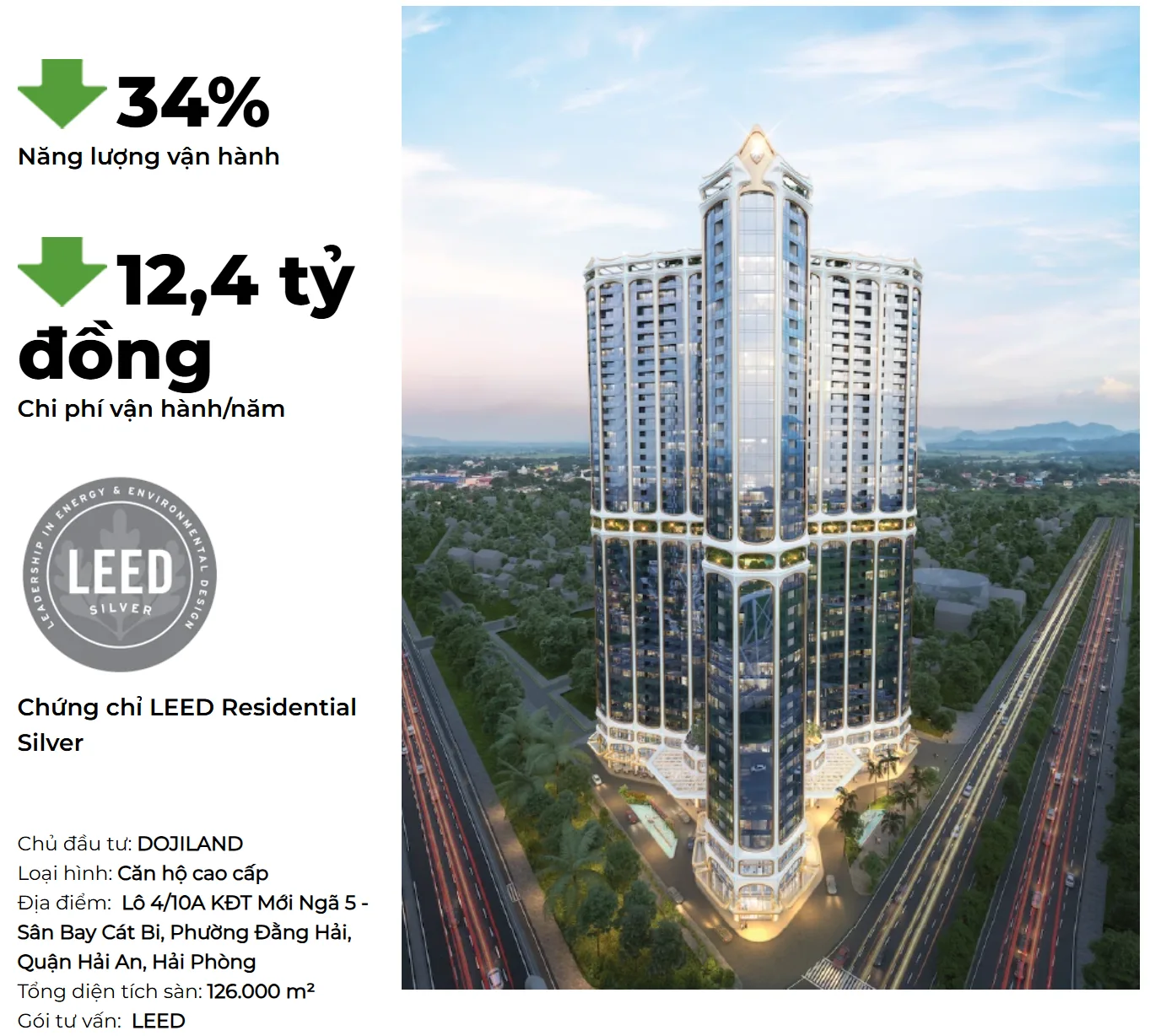
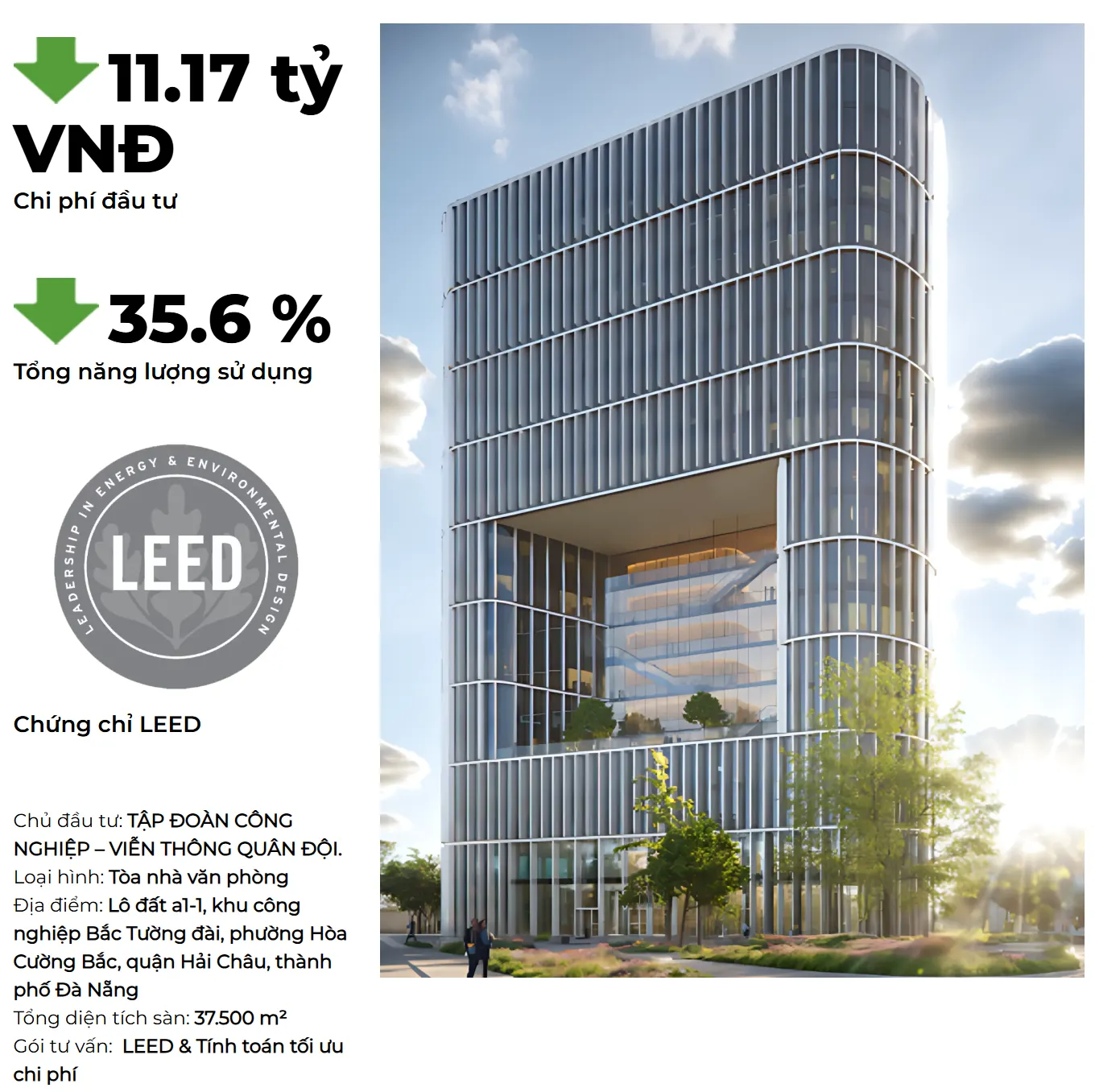
Thus, “green” is not simply an expenditure to attain a plaque. When calculated and integrated properly from day one, green building solutions can simultaneously optimize CAPEX, lower OPEX, bolster asset competitiveness, and generate enduring value across the building lifecycle.
3. The Essence of Green Building Certifications
Having examined the market context and undeniable economic returns, establishing transparent benchmarks requires a universal yardstick. That is the fundamental reason certification systems exist.
What is a green building certification? Essentially, it is an evaluation framework established and administered by independent non-governmental organizations to assess a building’s performance level, environmental responsibility, and indoor environmental quality. Certifications do not award points based on subjective impressions or design promises; they evaluate based on quantitative figures, technical simulation results, and empirical operational evidence. In other words, certification serves as a credible “endorsement” for Developers to prove to tenants and investors that: “My building is not merely green on paper; it genuinely consumes less electricity, emits less carbon, and provides a healthier work environment.”
In Vietnam today, the market is shaped by the four most popular and recognized green certification systems:
– LEED (USA – administered by USGBC)
– EDGE (International Finance Corporation IFC – World Bank Group)
– LOTUS (Vietnam – administered by VGBC)
– Green Mark (Singapore – administered by BCA)
To better understand the distinction between landscape aesthetics and substantive energy performance, refer to our detailed articles on Proper understanding of Green Building and Benefits Of Green Buildings
4. Which Factors Do Green Building Certification Standards Evaluate?
Whether choosing LEED, EDGE, LOTUS, or Green Mark, green certification standards revolve around the following four core pillars:
– Energy Performance / Energy Efficiency
– Water Efficiency
– Materials & Resources
– Indoor Environmental Quality (IEQ)
Satisfying green building certification requirements extends beyond administrative compliance; it demands verification via rigorous technical analyses. Within this framework, Building Energy Simulation) serves as the core tool, constructing a digital building model to evaluate options regarding the building envelope, materials, HVAC systems, and operating profiles. Grounded in international standards such as ASHRAE, energy engineers can optimize building energy performance, while lowering overall energy demand and rightsizing equipment capacities right from the schematic design stage.
5. Conclusion
Having established the value of green buildings and certification requirements, the decisive factor for success lies in the timing of implementation. Many projects incur substantial cost overruns by only integrating certification requirements after the design has already been finalized, forcing optimization through costly add-on measures.
The effective solution is integrating feasibility studies and Building Energy Simulation right at the Concept stage. Early evaluation optimizes the building envelope and reduces thermal load / solar heat gain, thereby downsizing HVAC system capacity and balancing capital investment across budget categories. Consequently, the project satisfies green building certification criteria, optimizes operational expenditure (OPEX), and maintains the total investment budget at an optimal level.
With in-depth engineering advisory capabilities, EDEEC leverages Building Energy Modeling (BEM) to evaluate design performance and advise on selecting the optimal certification system – such as LEED, EDGE, LOTUS, or Green Mark – empowering Developers to optimize both technical performance and project financial viability.
Contact us and submit your basic project parameters today to receive a complimentary sample implementation roadmap and preliminary investment feasibility assessment at: Contact
=====
Related Articles: